Current condition
Record the part and fixture drawings and revisions, sample condition, observed loading result and evidence used to confirm location. Keep the result, reviewer and any uncertainty together so the decision can be checked.
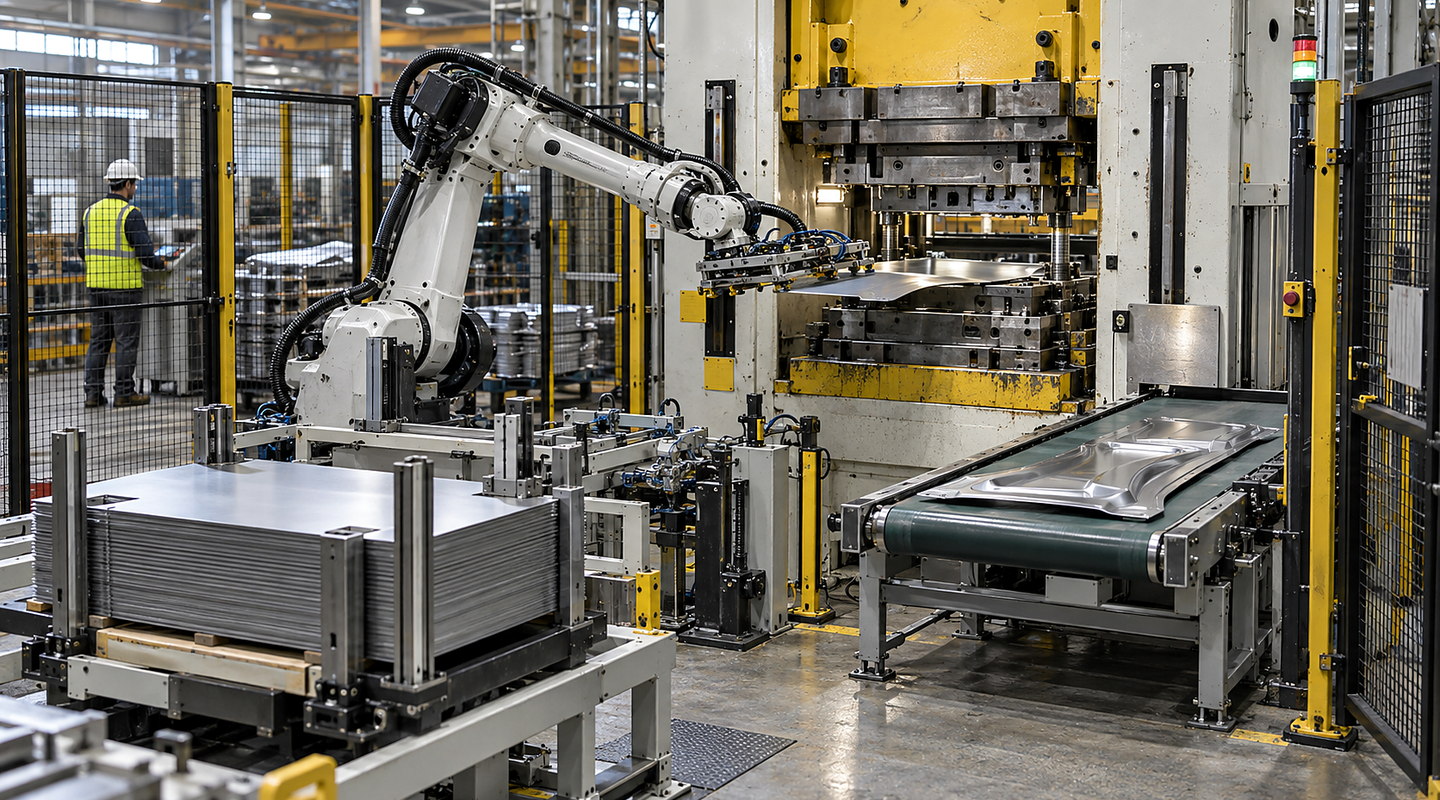
What evidence should be agreed before acceptance testing for robotic fixture loading?
Agree the part and fixture combinations, representative dimensional variation, assessed method and repetitions before run-off. Define acceptable approach, seating and release, the evidence for correct location and the condition required before the next process begins.
Keep conclusions tied to the combinations and conditions examined. Use the fixture-loading brief to identify the requirement each result must demonstrate.
Plan robotic fixture loading around your parts, process, cycle time, tooling, recovery and acceptance criteria. Discuss the highest-risk feasibility questions with Oxford Industrial Automation. Use this guide to resolve run-off criteria and production evidence before it limits the final system.
Discuss your application

Record the part and fixture drawings and revisions, sample condition, observed loading result and evidence used to confirm location. Keep the result, reviewer and any uncertainty together so the decision can be checked.
Cover the agreed part and fixture range, dimensional variation and production pattern. State which obstruction, missing-part and incomplete-seating cases are included in the assessed plan, and which combinations or conditions remain unexamined.
Separate completion of the loading movement from evidence that the part is correctly located for the next process. Record accepted results, uncertain results and required review separately, including any effect on the complete cycle.
For Robotic Fixture Loading Run-off and ramp-up checklist, describe the current position, required outcome, acceptable limits and known exceptions for part, product and process variation for robotic loading of production fixtures. That lets us compare options against your real production rather than one nominal value.
For Robotic Fixture Loading Run-off and ramp-up checklist, describe the current position, required outcome, acceptable limits and known exceptions for arrival pattern and presentation. That lets us compare options against your real production rather than one nominal value.
For Robotic Fixture Loading Run-off and ramp-up checklist, describe the current position, required outcome, acceptable limits and known exceptions for required cycle and production pattern. That lets us compare options against your real production rather than one nominal value.
For Robotic Fixture Loading Run-off and ramp-up checklist, describe the current position, required outcome, acceptable limits and known exceptions for tooling, sensing and process interfaces. That lets us compare options against your real production rather than one nominal value.
For Robotic Fixture Loading Run-off and ramp-up checklist, describe the current position, required outcome, acceptable limits and known exceptions for operator access, recovery and changeover. That lets us compare options against your real production rather than one nominal value.
For Robotic Fixture Loading Run-off and ramp-up checklist, describe the current position, required outcome, acceptable limits and known exceptions for run-off criteria and production evidence. That lets us compare options against your real production rather than one nominal value.